
 Kia Forte: Opening the hood
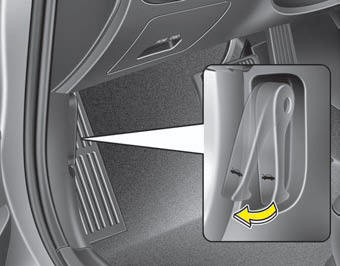
1. Pull the release lever to unlatch the hood. The hood should pop open slightly.
Open the hood after turning off the engine on a flat surface, shifting the shift lever to the P(Park) position for automatic transaxle and to the 1st(First) gear or R(Reverse) for manual transaxle, and setting the parking brake.
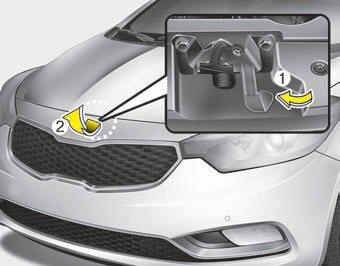
2. Go to the front of the vehicle, raise the hood slightly, push the secondary latch (1) left side and lift the hood (2).
3. Raise the hood. It will raise completely by itself after it has been raised about halfway.
WARNING
- Always double check to be sure that the hood is firmly latched before driving away. If it is not latched, the hood could fly open while the vehicle is being driven, causing a total loss of visibility, which might result in an accident.
- Do not move the vehicle with the hood raised. The view will be blocked and the hood could fall or be damaged.
Closing the hood
1. Before closing the hood, check the following:
- All filler caps in the engine compartment must be correctly installed.
- Gloves, rags or any other combustible material must be removed from the engine compartment.
2. Return the support rod to its clip to prevent it from rattling.
3. Lower the hood until it is about 1 ft. (30 cm) above the closed position and let it drop. Make sure that it locks into place.
WARNING - Fire risk
Do not leave gloves, rags or any other combustible material in the engine compartment. Doing so may cause a heat-induced fire.
WARNING - Unsecured engine Hood
If the engine hood is not secured properly, it is likely to fly up blocking your vision and causing a crash.
The support rod must be inserted completely into the hole whenever you inspect the engine compartment.
This will prevent the hood from falling and possibly injuring you.
 Hood
Hood
...
 Fuel filler lid
...
See also:
Spark Plug Cleaning
The combustion temporarily becomes unstable, due to the aged fuel and
the carbon deposits accumulated on the spark plug(s) after long-term storage.
[1st Method]
1.
...
Instructions
When Handling Refrigerant
1.
R-134a liquid refrigerant is highly volatile. A drop on the skin
of your hand could result in localized frostbite. When handling the
r ...
Specifications
Transaxle type
M6CF3-1
Engine type
Gasoline 1.8 MPI / Gasoline 2.0 GDI
4/5DR
2DR
Gear ratio
1st
3.308
3.615
...
Categories
- Home
- Kia Forte BD 2019-2026 Owners Manual
- Kia Forte BD 2019-2026 Service Manual
- First Generation
- Second generation
- Kia Forte TD 2014-2018 Owners Manual
- Kia Forte TD 2014-2018 Service Manual
